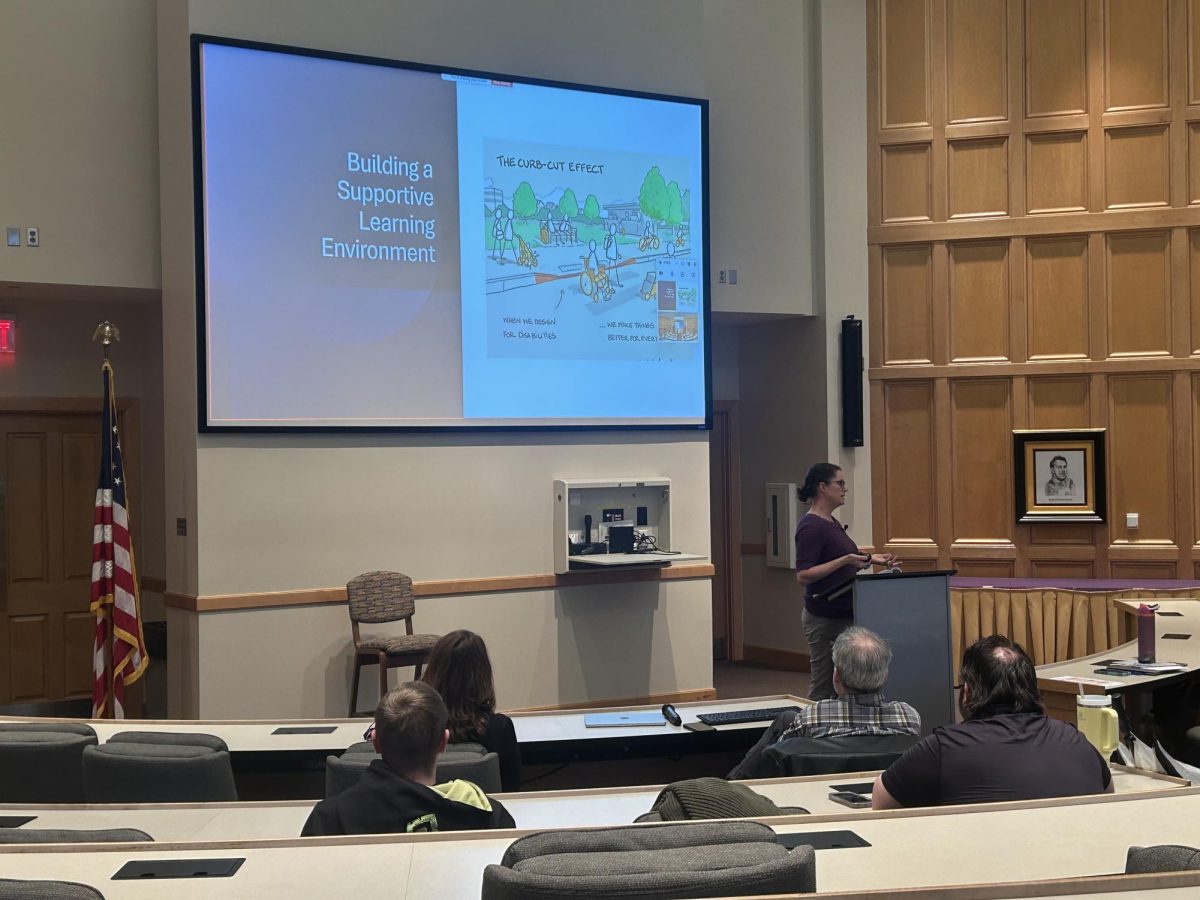
On March 3, the Writing and Communication Center (WCC) held guest speaker, Director of the Student Accessibility Center, Julie Donatini.
The talk gave insight into how professors and inspiring teachers can create a welcoming environment for neurodiverse students.
“We are going to work to normalize these conversations. This is actually one of my missions in my role here on campus is to teach all of you, faculty, students, everybody that we need to have these conversations,” said Donatini.
Donatini gave classroom strategies that can be used to help in difficult situations. Setting expectations, supporting strategies, managing disruptions and communicating to help create a better understanding of how to support students.
Different exercises were used to help better understand the conversation. The first exercise was writing down two things that the audience knew about neurodiversity and two things they wanted the talk to answer.
“On campus, for undergrads, 20 percent identify as having a disability, and only a third on campuses tend to use services for support. So, in your classroom, realistically, you have a lot of students that are not getting what they need or not identifying that they need something that is common,” said Donatini.
Donatini primarily focused on Dyslexia, ADHD and Autism, explaining how these diagnoses affect students and what can be done to support students in the classroom.
The second exercise was getting a partner and having a conversation without using words with ‘r’s in them. The exercise was to help explain how people who have communication processing issues and it can be hard to gather information from them.
Case studies were also used to help advise professors on how they can handle difficult situations, like a student asking 15 or more questions, which is taking up a lot of the class time, and how to tell them in a supportive way that you must continue with class.
“Understanding that we see behaviors at the surface level, but we don’t always know what’s going on and what’s at the root of those,” said Donatini.
The talk ended with a video of three Ashland students speaking about their experience at AU and how professors have helped with their learning.
“I want you to consider what feels familiar in your own classroom, what small shifts could make a difference, and how intentions might matter as much as strategy,” said Donatini.
Educating faculty and allowing communication for students can create a welcoming environment for students and could impact their overall learning experience.
For more information, contact the Student Accessibility Center.