Ashland University offers a plethora of courses, whether it’s a degree in biology, journalism, education or business; AU features a wide range of different specialties to study.
One of these specialties is the Criminal Justice and Sociology department.
The department is a 120-credit hour program offered at the university, giving students a hands-on learning experience to better understand concepts in and around law enforcement, forensic science, law, sociology and other disciplines concerned with criminal justice.
According to the university, the department is continuously in contact with the local law enforcement to help fine-tune the program and its curriculum.
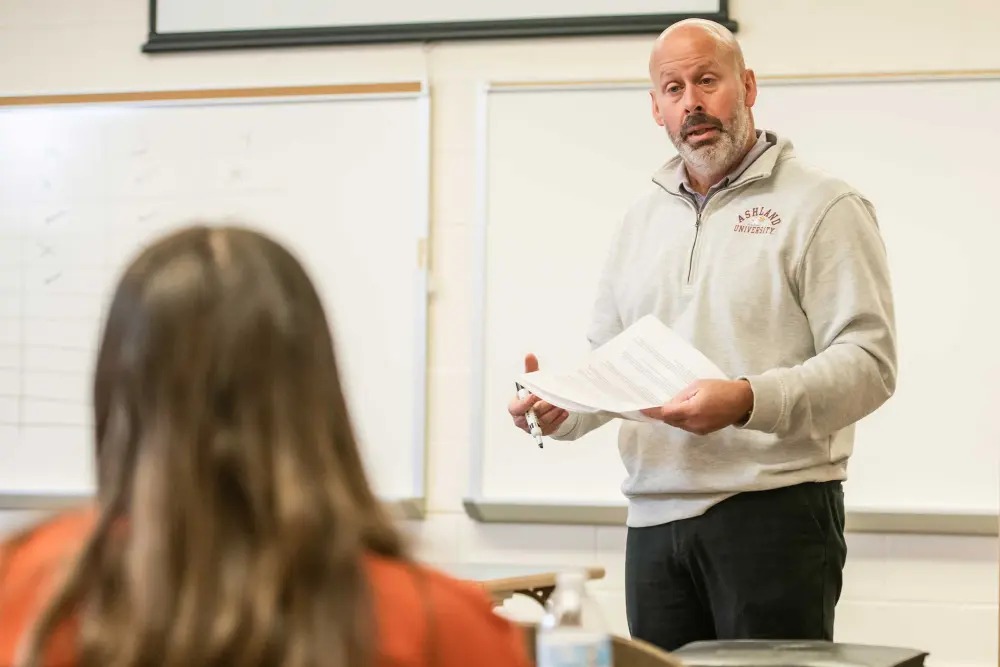
The program utilizes various professors fortunate enough to have had hands on experience with this specialty, one of which being Assistant Professor of Criminal Justice Herb Homan.
Prior to his professional career at AU, Homan served 34 years with the Ohio State Highway Patrol. In 2022, he retired from his job as a highway patrolman when he began his career at AU, starting out as a visiting assistant professor.
Homan finds that the program is more than what people perceive it as.
“The Criminal Justice program is more comprehensive than maybe what people recognize when they think criminal justice,” Homan said. “Initially what jumps to mind is probably law enforcement or police, but that is just one component.”
Homan continues by highlighting the opportunities that often arise from obtaining a degree from the department.
“Many are very practitioner based. They are looking to use that degree to get right into an occupation,” Homan said.
These occupations often range from law enforcement, such as police, probation, parole or positions within the court system. Others look at this program through the lens of a more foundational approach. “We have a lot of students that are interested in becoming attorneys or lawyers down the road,” explains Homan.
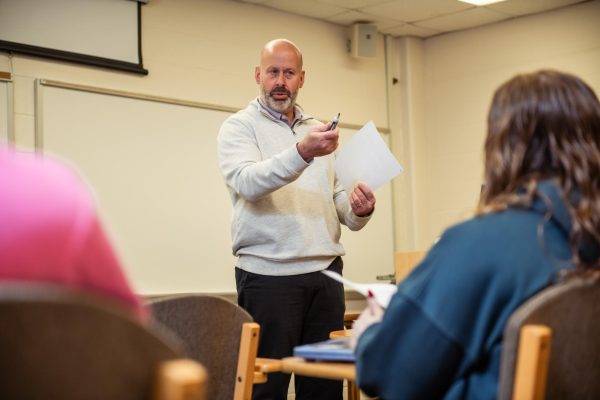
Professor Homan is a prime example of how students pursuing a career in criminal justice can apply themselves to the field.
“At every stage, I looked for education to enhance my ability to do my job,” says Homan.
At 18-years-old, Homan was hired by the highway patrol. After a couple of years, he acquired an associate degree in business to enhance his understanding of the business side of the field. Following Homan becoming an officer, he went back to school to get his undergraduate degree in psychology. “I started realizing…if i could understand why people do what they do, that might give me some tools to better function.”
Homan moved up the ranks, and as he did so, he recognized the importance of building his knowledge within the field of criminal justice. This was when he eventually pursued his master’s degree in criminal justice and a doctorate in organizational development toward the end of his career. He was then able to apply these studies to help him become a more well-rounded officer.
“When I look at the criminal justice system as a whole, and what we’re looking to educate here, it’s not so much what you do, its understanding why you’re doing it,” says Homan.
Professor Homan, along with the rest of the criminal justice department, strives to push for that “why” in what they teach: the application of what they are learning within the classroom to how they can effectively carry out their duties in the field.
“What we are trying to do is put context to the theory. Context to the textbook. Here is what we’re teaching you, but here is how it applies in real life,” says Homan. On the one hand, the department aims to show how to apply these concepts to real world problems. On the other hand, they hope to accomplish teaching their students on the more academic side of the industry, involving their students in a more scholarly way.
Senior criminal justice major MK Prall comments on how the department’s real-world application and academic instruction is preparing her to participate in the field of law enforcement: “I feel like the program has set me up for success. We are able to choose classes that are geared towards what we want to do with our major and the professors are great at setting us up with professionals to chat or to get internships with.”
Not only that, but the department has also supported students like Prall to explore opportunities outside of the law enforcement system. “I have applied to go to Air Force Officer Training School,” a discipline that is not always immediately associated with criminal justice. “CJ is not fully related to this field, but some classes can be translated to other fields such as research, policies, and understanding decision making.”
“CJ has prepared me by giving a solid foundation of all aspects of law enforcement including courts, constitution, policing, research, policy, investigation, as well as understanding how fast first responders have to make decisions,” says Prall.
The criminal justice department at AU is more than just a field of academics. It’s an opportunity for students to not only learn more about a vast and intricate career field, but also to understand how to apply themselves in all areas of their studies, whether it’s within a traditional law enforcement career or not.