

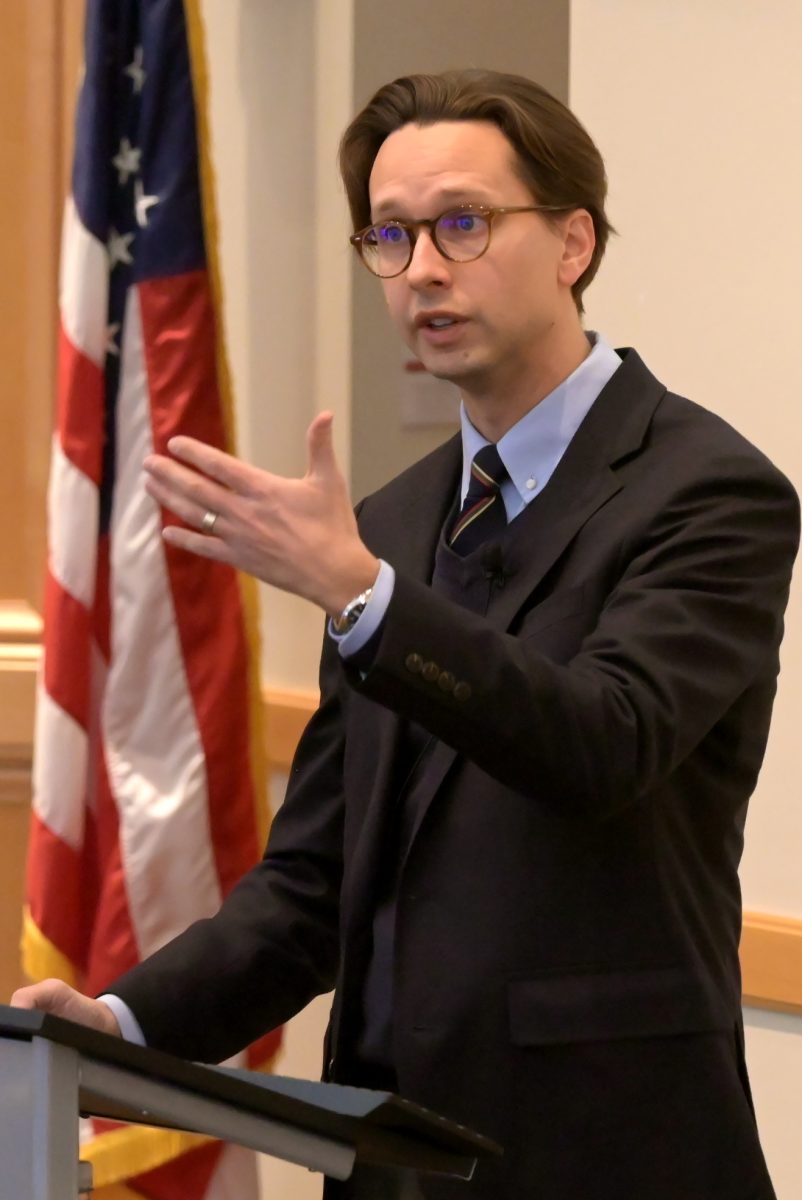
On Jan. 16, The Ashbrook Scholar Program welcomed Dr. Tony Basham as they held their first colloquium of the semester.
The event took place in Ronk Lecture Hall on campus and began at 3:00 p.m., where many Ashbrook scholars filled the room to listen to the guest from Ashland University’s Theological Seminary.
Basham is Assistant Professor of New Testament and Assistant Director of Student and Program Development at the seminary. In this position, he helps oversee the pre-seminary track for AU students with a major or minor in religion.
Before his time at AU, Basham earned degrees at Emory University in Atlanta and Durham University in England. He then completed his Ph.D. in Early Judaism and New Testament Studies at McGill University in Montreal, Quebec; here, he received multiple awards and scholarships such as the Travel Award for McGill Ph.D. students to the University of Glasgow, Scotland.
From 2019 to 2021, Basham was an assistant researcher for the Oxford Press-funded project based in Cambridge, MA; he had written and contributed to multiple works on the history of the New Testament having been used in Greek terms.
The colloquium was centered around Basham’s book and Ph.D. dissertation from 2022, “Paul, the Temple, and Building a Metaphor.”
Throughout the evening, he discussed several important points and findings he has come across during his research process.
In his book, Basham specifically discussed his five-point framework as to what Paul observes and expects of the Corinthian believers.
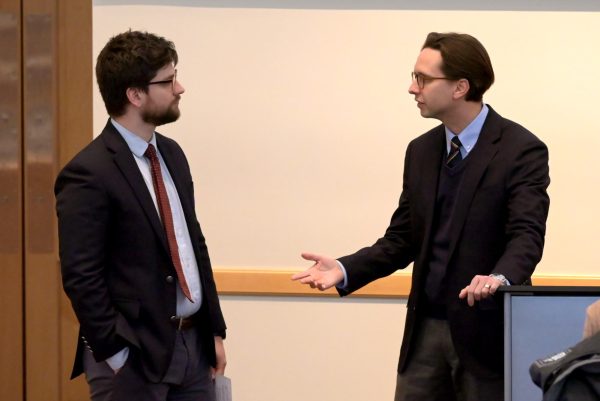
Later, the term, “metaphor” was discussed, as it is a prominent part of the book’s title. “I found a common thread of all these studies from ancient to modern, of people who consider metaphor utterly persuasive in the way we structure our realities,” said Basham.
“Metaphor ology, as a field, falls under cognitive linguistics and a fundamental characteristic of cognitive linguistics is that language imposes a structure on the world, rather than just mirroring your protective reality.
Basham continued to connect the dots throughout his book, relating all three: Paul, the temple and metaphors as a whole.
“Language is a way of organizing knowledge that reflects the needs, interests and experiences of individuals and cultures,” he said.
As many scholarly events do, the gathering ended in a question-and-answer session, where Ashbrook students and professors were able to voice their opinions and ask intriguing questions.
As the question- and-answer session came to a close, Basham shared another outlook on his research on early Christian origins, and what he sees moving forward. “I’m worried today for a lot of Christan churches that were functionally Marcionite, in the sense that we don’t really understand the Old Testament; we just read the New all the time, and we don’t know how to connect the dots,” he said.
“So there’s not an abandonment of average tradition, but it’s reimagined, and we’ll adjust; I think Paul is doing it.”
After the event ended, many enlightening conversations continued as students and professors filed out of the lecture hall.
The Ashbrook Scholar Program’s next event is a luncheon where they will be welcoming Lee Owens, Dan Niss and Bob Sebo at “The Spirit of a Team: Strategies for Achieving Excellence.”


Sadie Vanderzyden • Jan 29, 2026 at 8:48 am
Great article! I’m commenting to clarify the quote: “I’m worried today for a lot of Christan churches that were punctually Marcionite…” I believe Dr. Basham said functionally Marcionite, not punctually.