Ashland University has a total enrollment of 6,419 students as of April 2026, 84% of those being undergraduate students. Of these undergraduate students, over 3,000 live on the university’s campus in one of the seven residence halls.
One of these halls has a unique history, its contents stretching from classrooms and offices to dorm rooms to now a first-floor renovation.
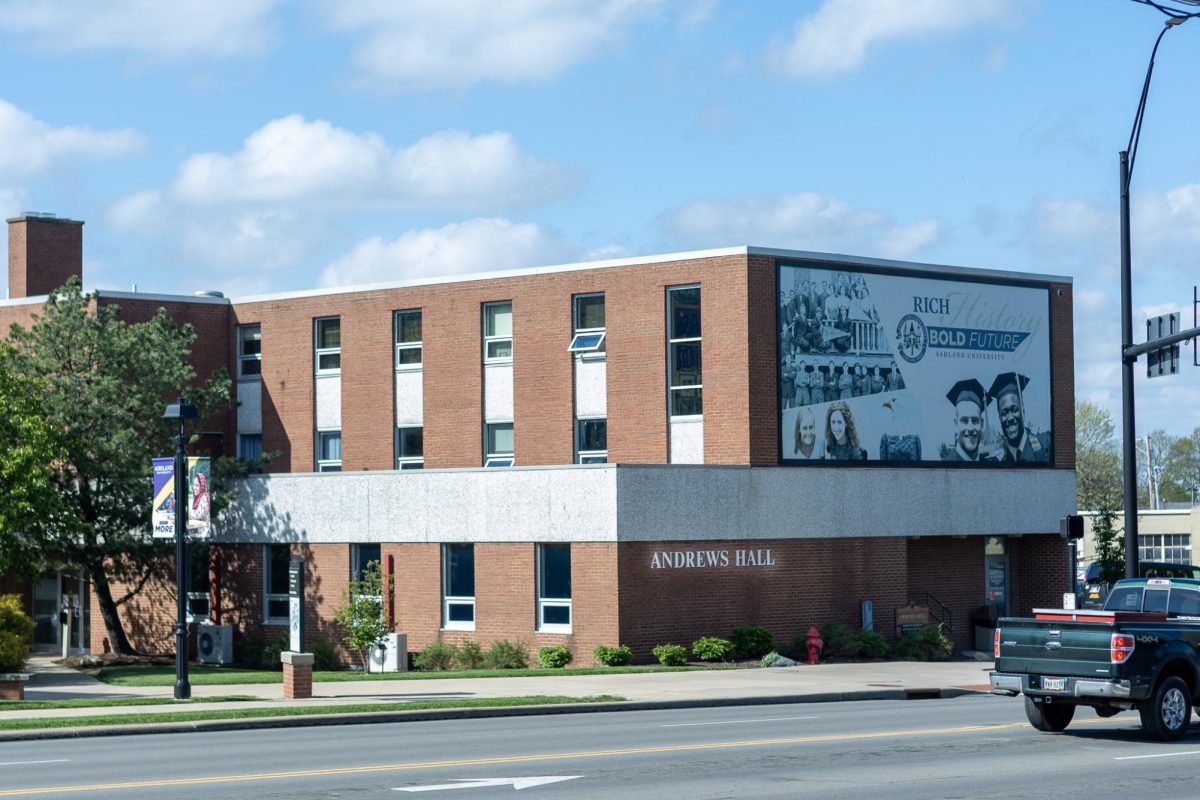
Located on Claremont Ave., Andrews Hall was built in 1968 and was named after Dr. May Pyle Andrews.
A face to go with the name
Andrews was a beloved professor of English at Ashland College, now University, and taught for 43 years, eventually retiring in the late 1960s. She was a highly regarded educator and was awarded a Doctor of Letters Degree in 1966.
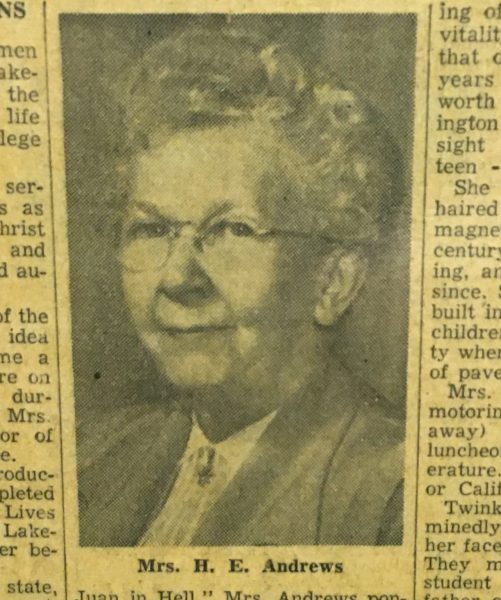
In 1967, Andrews and her late husband, Reverend H.E. Andrews who passed away in 1957, donated around 14,000 books to the university, forming the foundation of what is now AU’s Special Books Collection, located on the third floor of the Archer Library.
The books in this collection are considered to be rare, unique or fragile and cannot be checked out of the library; they can be viewed in the Special Books room with an appointment with the curator. To set up an appointment, guests can contact the curator at [email protected] or stop by her office on the first floor of the library.
According to an article titled, “Take Formal Bows Sunday,” in The Collegian circa 1970, the building was named after Andrews, “in recognition of her deep interest in the intellectual and spiritual motivation of young people and as an outstanding teacher and gracious leader.”
Andrews held degrees from Huron College and the University of Chicago, with further studies at Columbia University and the Shakespeare Institute in Stratford-on-Avon. She was born in Miller, S.D. on May 1, 1888, and had two children, Harold Edward Andrews Jr. and John Pyle Andrews. She passed away on Nov. 26, 1974, in Los Altos, Calif. However, she rests in the Ashland Cemetery in Ashland, Ohio.
The first floor
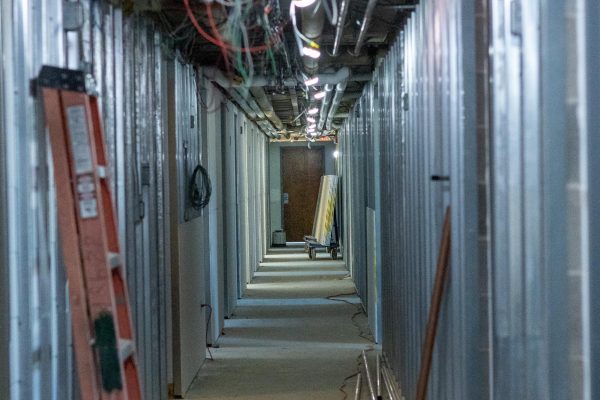
The ground floor of Andrews Hall sat vacant and untouched for years until December 2025.
For much of the building’s history, this floor was used as an academic space, housing three classrooms and multiple faculty offices.
“Those were largely history and political science classes,” said Rick Ewing, vice president, operations and planning at AU.
“The first floor was academic up until three years ago when, I think, the faculty started moving out of there. I think classrooms were still there two years ago, but last year there were no classes held in Andrews,” said Ewing.
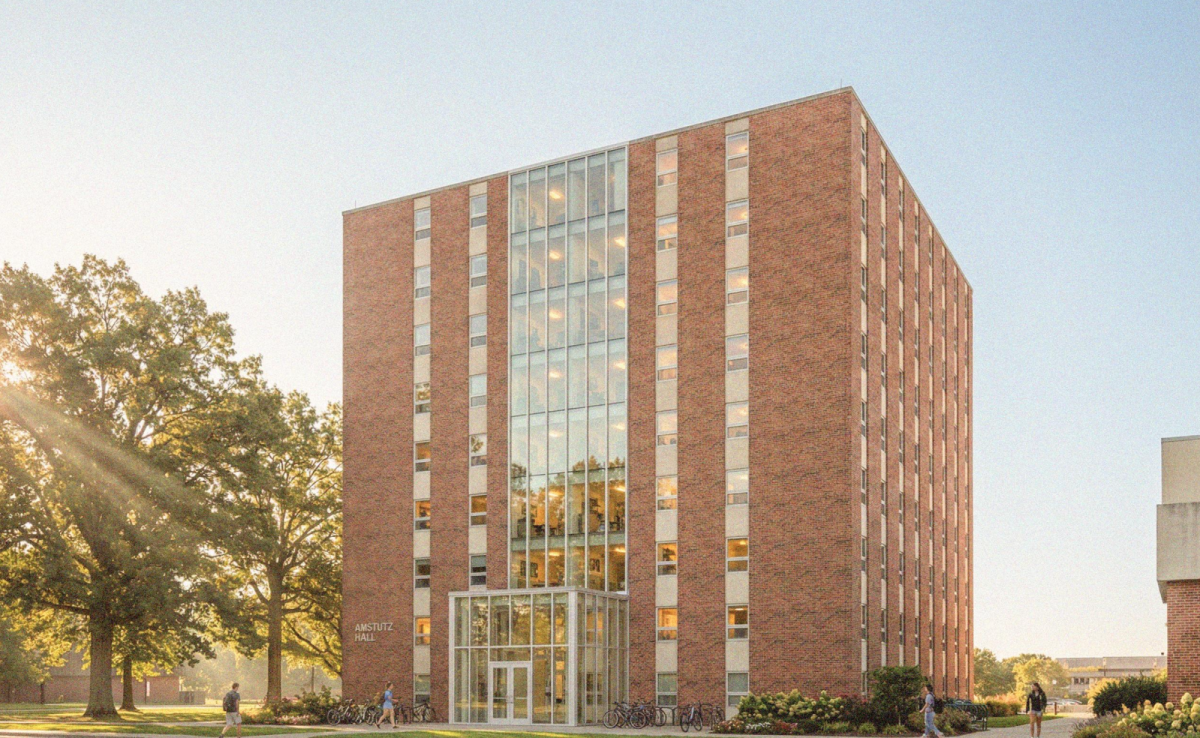
Now, this floor is getting a renovation similar to other residence halls on campus such as Amstutz Hall and Jacobs Hall.
The project is funded by several donors.
“Jack Miller is funding it and it’s going to be somewhat supportive of the women’s basketball team; they’re going to kind of have the opportunity to live in this first floor,” said Ewing.
AU’s Residence Life did not respond when a comment was requested about what group of students will be living on the floor in the upcoming semester.
The AU Women’s Basketball team also could not be reached to discuss this matter.
There are also funds coming from Bob and Ian Archer, as well as Dwight Schar and, “potentially a couple other smaller donors that have yet to be identified,” said Ewing.
There are going to be 15 rooms for students to live on this floor, set up as “doubles,” for two students per room.
There will also be six pod-style restrooms in the space; each of these will provide a more private space with one shower, toilet and sink.
“There’s going to be a single apartment for an RLC, (Residence Life Coordinator), or whatever we need to use it for, for residence life,” said Ewing.
There will also be a suite or lounge space similar to Clark Hall’s sorority suites. This space will have a small kitchen and seating space.
Changes are also coming to the outside of the building, which has remained nearly the same throughout its history.
There will be a new storefront on the side of Andrews that faces Claremont, which will act as the new main entrance. Lastly, a multipurpose room will be added to the first floor.
This will be, “a large room to be used for watching movies or playing games, or different events that might take place there,” explained Ewing.
Like the second and third floors, the first floor will also have air conditioning.
The first floor is set to be complete and ready for students to live in by the beginning of the fall semester.
“It’ll be done well before the end of the summer,” said Ewing.
“When I was a student, the first floor was classrooms and a lot of faculty offices, even some faculty offices on the second floor,” said Ashbrook Director of Student Programs, Ben Kunkel.
History and political science classes were primarily held here.
“I’m not sure what other departments were in there when I was a student because I was a history and political science major, which may not be a surprise since I work at Ashbrook,” said Kunkel. “So, I had a lot of my classes in there and a lot of my professors had their offices in there.”
The Ashbrook Center at AU is an independent, non-profit center that promotes education in American history and government; it aims to strengthen constitutional self-government.
The center offers the undergraduate Ashbrook Scholar Program, summer Ashbrook Academies for high school students and resources for teachers.
It was originally located in the Archer Library and eventually moved to the Dwight Schar College of Education in 2022.
“Around that same time, all of our faculty moved over from Andrews, which the first floor was in really bad shape,” said Kunkel.
“It just wasn’t cool to have people working in that environment, so they [the History and Political Science Departments] moved over to the other side of Schar,” explained Kunkel.
Today, the second and third floors of Andrews Hall house only Ashbrook students.
“I think Ashbrook will probably benefit from it in some ways. We hope that the first floor will have some common spaces,” said Kunkel.
The second and third floors
While the first floor of Andrews Hall has interesting history, the second and third floors do as well.
Today, there are 26 residential rooms on the second floor and 23 on the third floor, one being all male and the other all-female students.
Andrews Hall prioritizes housing freshman Ashbrook students to keep a familiar and welcoming community for those who are new to college life. However, students of all years live in the building.
“Typically, what has happened is that the freshmen would get put in there first, and then if I have extra rooms left over, which I almost always do, if an upper classman wanted to live there, they could,” said Kunkel.
“It’s nice to have a few upper classmen up there and you can kind of be the voice of reason — mentor them, answer questions that they might have about how to write a paper for this professor, or ‘who’s the best professor to take English with,’” explained Kunkel.
Before Andrews Hall became a place for Ashbrook housing, the second and third floors were renovated.
“We got an estate gift from a donor out in California who our director at the time, Peter Schramm, had developed a relationship with, and as a part of his will, he gave us a pretty substantial amount of money to be used toward a facility of some sort,” said Kunkel.
Instead of building a new facility, they decided to renovate the third floor of Andrews Hall.
“It was probably one of the worst floors at the time, so the university was pretty eager to see something happen to improve it,” explained Kunkel.
From that point on, first-year Ashbrook students were prioritized in housing in Andrews. “It was kind of a nice way for them to develop some camaraderie with-in the program as well, during that first year,” said Kunkel.
“I really enjoyed living in Andrews Hall,” said first-year Ashbrook student, Makaylea Baker.
“My favorite part about living in Andrews is being in the common room on late nights, laughing and making good connections with the other residents,” said Baker.
The residence hall is conveniently located beside the convocation center, where students can use their dining dollars for meals. Andrews is also close to another freshman residence hall, Kem Hall, and the Hawkins-Conard Student Center, which has study spaces, the Safety Services help desk and Eagle’s Nest as another food option.
However, many Andrews Hall residents tend to spend most of their time in Schar, where the Ashbrook headquarters are located, along with their history and political science courses.
“With most of my classes being in Schar, I wish that Andrews Hall was closer because I have to walk all across campus to get to my classes,” said Baker.
Many first-year students experience this; Kem Hall and Amstutz Hall, which was previously a majority-freshmen dorm, are also on the other side of Claremont, separating them from the rest of campus.
Still, this tends to create a sense of community among first-year students that are experiencing a new chapter of their lives.
“I think that this is a great dorm for freshmen because it helps them bond and connect with people that have similar interests and hobbies,” said Baker, closing in on the end of her first year of college.

(Aubrey Wood)